Free checklist and template · No signup
Golf tournament planning checklist
Planning a golf tournament comes down to five decisions made early (purpose, course, date, format, price) and a list of small jobs done on time. Put your date in below and each stage gets a deadline. Download it as a spreadsheet or print it.
Checklist · Format · Field and timings · Budget · Charity days · Software
The checklist, worked back from your date
Pick the kind of day and the list changes: sponsor and raffle jobs drop out for a club day. The six-month start suits a charity or corporate event. If you have less time, do the first two stages this week and the rest still holds.
Add your date and every stage gets a deadline. 0 of 40 done.
6 months before
4 months before
2 months before
1 month before
2 weeks before
The week of
On the day
The week after
Ticks are kept in this browser only. The spreadsheet opens in Excel, Numbers or Google Sheets with Owner and Done columns to fill in.
Want the blank version? Download the golf tournament planning template (CSV) with every task, a stage, and Owner and Done columns.
Choose the format before you set the price
The format decides how long the round takes, whether you need handicaps and how the prizes work, so settle it before entries open.
| Format | Suits | Scoring | Rules |
|---|---|---|---|
| Scramble | Charity and corporate days, mixed ability | One score per team per hole | Scramble rules |
| Stableford | Club and society days with handicaps | Points per hole, highest total wins | Stableford scoring |
| Better ball | Pairs events | The better net score of the two counts | Better ball rules |
| Stroke play | Championships and qualifiers | Every stroke counts, lowest total wins | Stroke play rules |
If any prize is net, collect a Handicap Index from every player and say on the entry page what happens to players without one. For a scramble, work out each team's handicap with the scramble handicap calculator. For individual and pairs formats, use the playing handicap calculator.
Put four things on the rules sheet whatever the format: which tees, the maximum score on a hole, whether mulligans can be bought, and how a tie is split. A card countback (best back nine, then back six, back three, last hole) is the usual way when there is no time for a play-off.
Field size and the timings for the day
A shotgun start sends every group out at once from different holes, so everyone finishes together and the meal can start on time. Tee times use the first tee only, which suits smaller fields and courses that will not close for you. Enter your numbers to see how many groups you have and when the prize giving can start.
18 groups
Fits a shotgun with one group on each tee.
- Registration opens
- 12:00
- Welcome and rules
- 12:45
- Shotgun
- 13:00
- Last group in
- 17:30
- Prize giving
- 18:00
Registration is set an hour before the first group, the welcome 15 minutes before, and prize giving half an hour after the last group is in. Ask the course what a round takes there in your format.
A budget you can check in one line
Most of the cost is what the course charges per player. The rest (prizes, signs, tee gifts, insurance) is fixed whether 40 people come or 100, which is why a half-full field loses money. The break-even field is the number of players at which entry fees and sponsorship cover everything.
3,180 left over
- Money in
- 12,300
- Money out
- 9,120
- Break-even field
- 24 players
Use any currency. Other costs are the ones that do not change with the field: prizes, signs, tee gifts, insurance, printing. Raffle, auction and mulligan income sits on top of this.
Charity golf tournament planning
A fundraiser makes its money in three places, and entry fees are usually the smallest.
Sponsors. Sell a small number of clear packages: a title sponsor, a sponsor for each hole, one for each contest and one for the meal. Write down what each gets (a sign on a tee, a logo on the scorecard and leaderboard, a team in the field) and deliver exactly that.
On the day. Mulligans, a raffle, a putting contest and a longest drive or nearest the pin on sponsored holes. Raffles, auctions and prize draws are regulated differently from place to place, so check the rules where you are before selling tickets.
After. Tell players and sponsors what was raised within a week. It is the best invitation to next year.
Use a scramble unless your field is mostly regular golfers. The scramble guide covers drive minimums and team handicaps.
Golf tournament planning software: what Chalk covers
A spreadsheet is enough for the jobs above. Software earns its place in the fortnight before and on the day, when entries, tee times, scores and print all have to agree. Chalk Golf is a golf app for iPhone and Android with event tools built for that part.
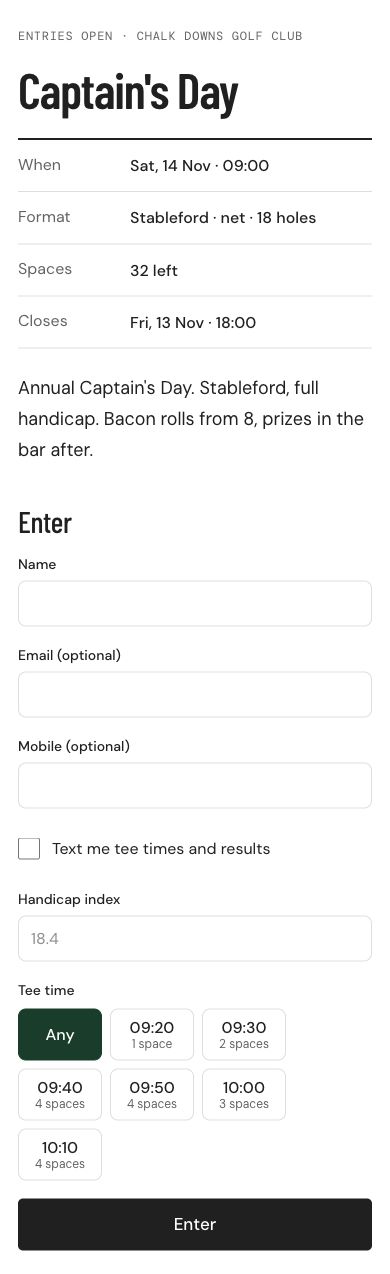
Entries and tee times. Share one link. Players sign up in any browser with their name and Handicap Index and pick a tee time with space. Entries close by themselves at the field limit or the closing time.
Groups and handicaps. One tap builds the playing groups from the tee sheet. On a net competition Chalk works out each entrant's course handicap from the tee's rating.
Scoring. Groups score on their phones in stroke play, Stableford, match play, skins or a team format. Scores for players without the app can be entered by their group or the organiser.
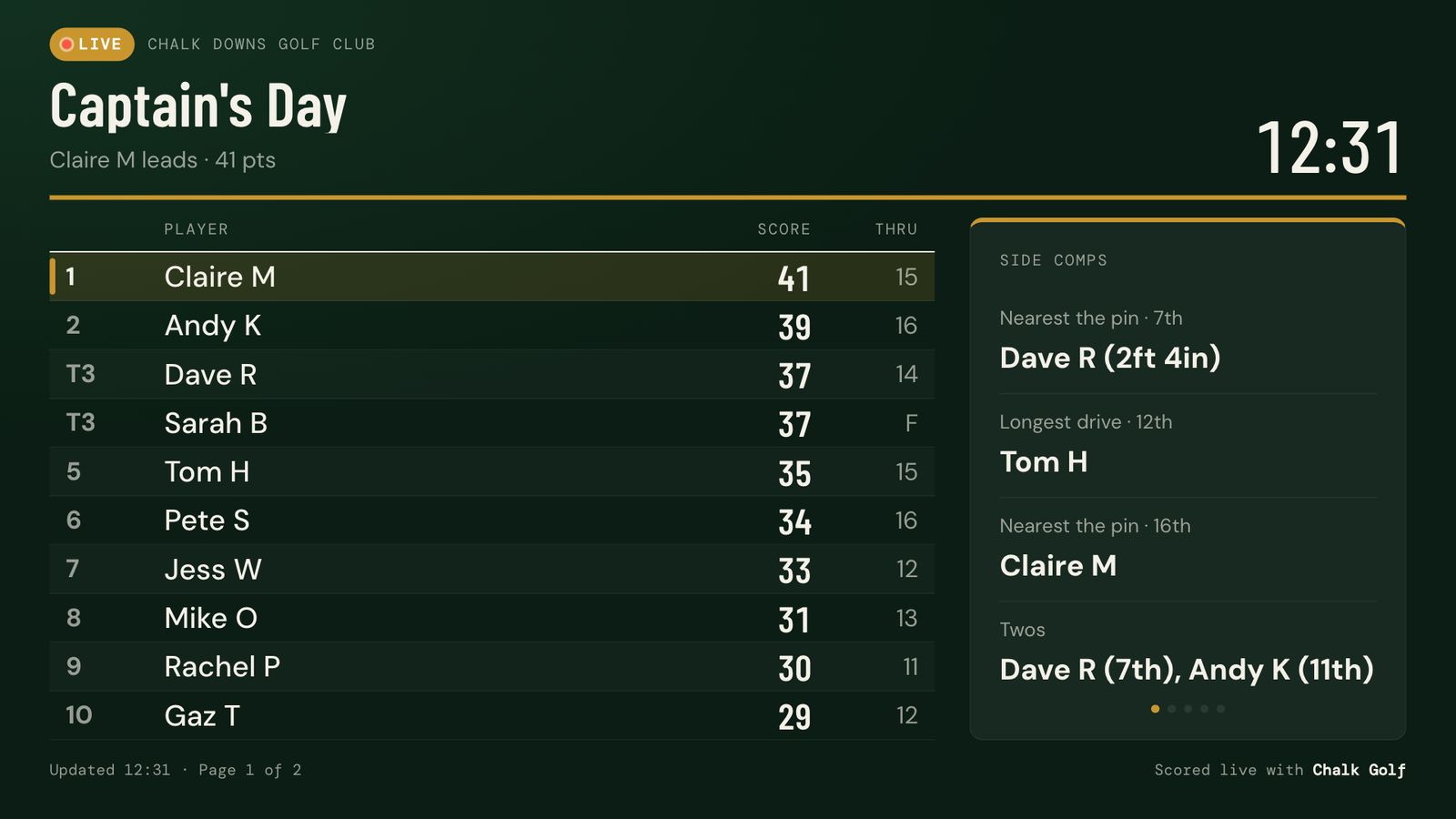
Leaderboard. A live board anyone can open from a link, and a TV board for the clubhouse screen that pages through the field and rotates sponsors and side competitions.
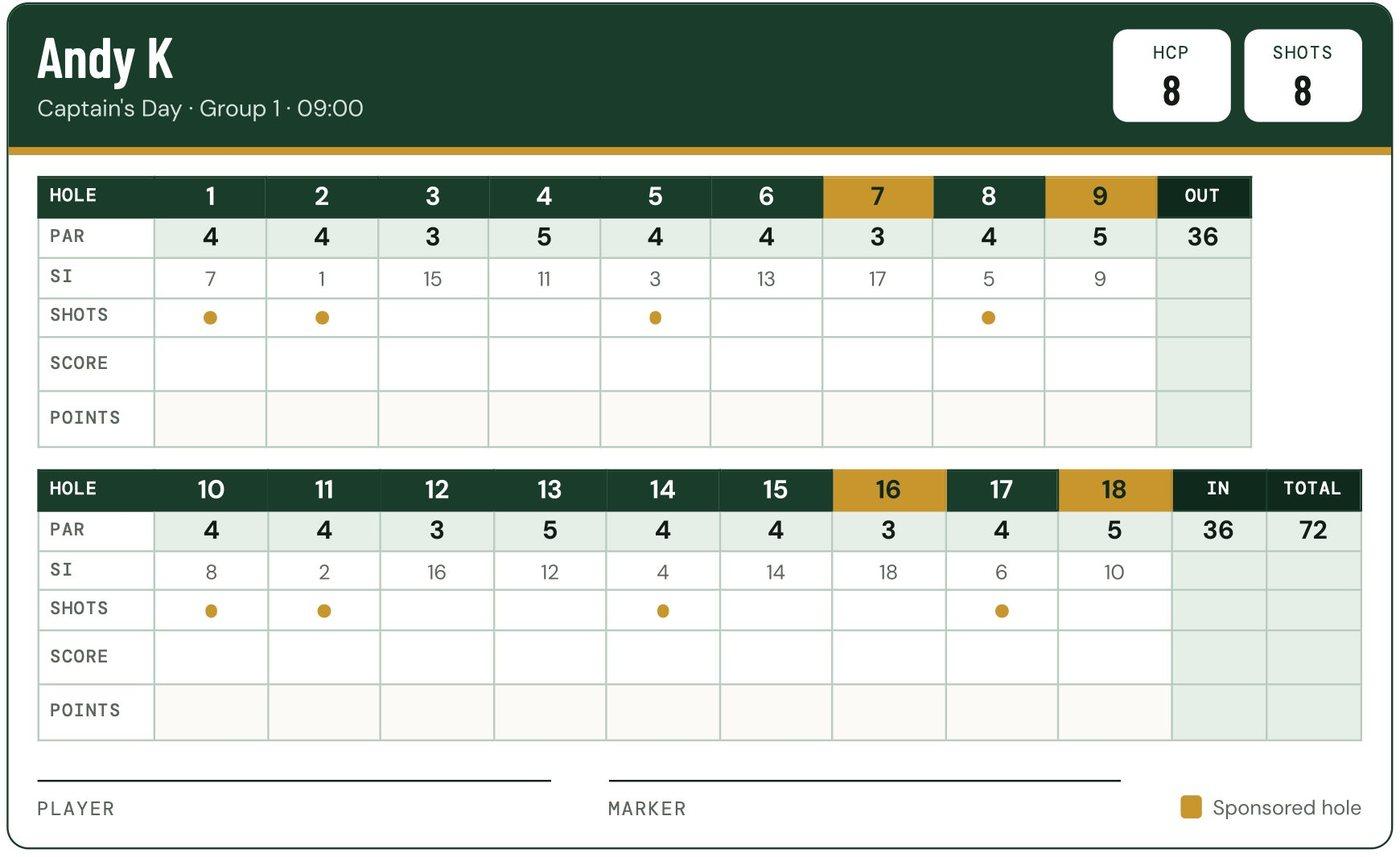
Sponsors and print. Sponsor logos and the holes they sponsor appear on the entry page, the boards and the printed sheets. The print pack is a draw sheet, a scorecard for every player with the strokes they receive, and a results sheet.
On a Mac. The Events tab in Chalk Tracer for Mac shows the same event on a big screen, so a laptop plugged into the clubhouse TV can run the leaderboard.
What it costs, and what it does not do. The organiser needs Chalk Pro ($9.99 a month or $69.99 a year). Players sign up and score free. Chalk does not take entry fees or donations, so collect those the way you already do. The full walk-through is on the event tools page.
Questions
How far ahead should you start planning a golf tournament?
Six months is comfortable for a charity or corporate day, because the course date and the sponsors both need that long. A club or society day with no sponsors can be done in six to eight weeks if the course has the date free.
How many players can play in a shotgun start?
One group of four on each of 18 tees is 72 players. Putting a second group on some or all holes takes it up to 144. Past that you need two waves or a second course.
What is the best format for a charity golf tournament?
A four-player scramble. Every player hits every shot from the team's best ball, so beginners can contribute and nobody holds the field up. For a field of regular golfers with handicaps, individual or team Stableford is fairer.
Is there free golf tournament planning software?
The checklist, spreadsheet and calculators on this page are free and need no account. Chalk's event tools (entry page, tee sheet, live and TV leaderboard, printed scorecards) need Chalk Pro for the organiser, which is $9.99 a month or $69.99 a year. Players never pay.